
Extended Producer Responsibility (EPR) in the EU: A 2026 Guide for Product Companies
What EPR means for EU product companies in 2026: packaging, WEEE, batteries, textiles, obligations, schemes, and how to stay compliant across markets.
By Complir
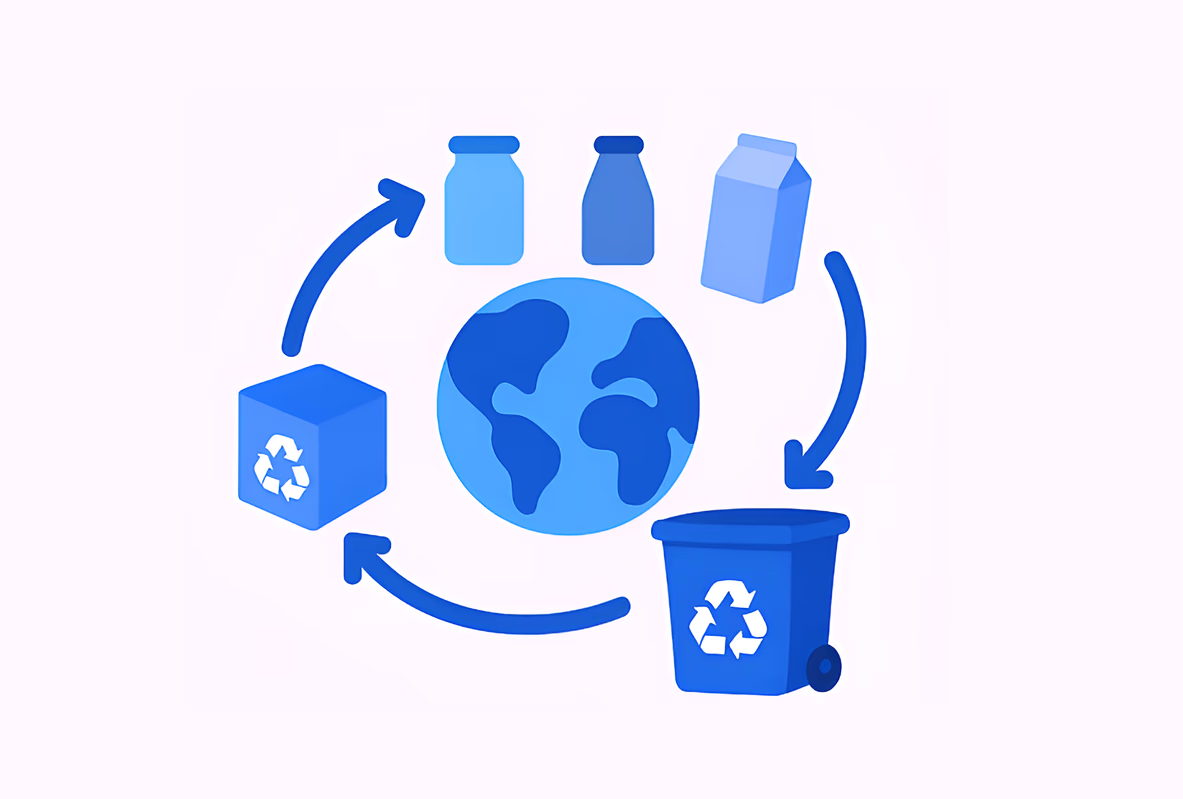
Extended Producer Responsibility (EPR) is the EU policy principle that makes producers financially – and often operationally – responsible for what happens to their products once consumers are done with them. If you place packaging, electronics, batteries, textiles, or a growing list of other product types on the EU market, EPR obligations almost certainly apply to you.
This guide explains what EPR is, which product streams it covers, what's changing in 2026, and why getting it right has become materially harder – and more expensive – over the past two years. It is a 2026 snapshot of one of the fastest-moving areas of EU product regulation, with the Packaging and Packaging Waste Regulation taking effect in August 2026, the new Batteries Regulation already in force, and textile EPR rolling out across Member States through 2027–2028.
Which products are covered by EPR?
EPR in the EU applies to a growing list of product streams. The most established are packaging, electrical and electronic equipment (WEEE), and batteries, with newer or expanding schemes for textiles, tyres, furniture, single-use plastics, and end-of-life vehicles. Exact categories and fee structures are set by each Member State, so the same product can carry different EPR obligations from one EU market to the next.
What does EPR mean for product companies?
For product companies, EPR means registering with the relevant national scheme in every market where you sell, reporting the volumes and materials you place on the market, and paying fees that increasingly vary with how recyclable or sustainable your product is. It usually also requires accurate, SKU-level material data, an authorised representative in markets where you have no local entity, and ongoing tracking as new streams such as textiles come into force.
What Is Extended Producer Responsibility?
The "polluter pays" principle, operationalised across the EU
Extended Producer Responsibility is a policy tool that extends a producer's financial or operational responsibility for a product to cover the post-consumer stage – collection, sorting, recycling, and disposal of the waste it generates. It operationalises the "polluter pays" principle in EU waste policy.
The legal foundation sits in Article 8 and Article 8a of the Waste Framework Directive (Directive 2008/98/EC). Article 8a, introduced in the 2018 revision, sets the general minimum requirements that every national EPR scheme in the EU must meet – covering producer registration, reporting, financial contributions, and oversight of the Producer Responsibility Organisations (PROs) that administer the schemes.
In practice, EPR works like this: instead of municipalities absorbing the full cost of waste collection and recycling, producers pay a fee for every unit they put on the market. The fee funds the infrastructure that handles the product at end-of-life – and, increasingly, is modulated based on how recyclable or sustainable the product is.
Who Has EPR Obligations in the EU?
The definition of "producer" is broader than it sounds
Under most EU EPR schemes, a producer is any legal entity that – regardless of the selling technique used, including distance selling – first places a product on the national market of a Member State. That typically includes:
- Manufacturers that sell under their own brand
- Importers bringing products into a Member State from outside
- Distributors or retailers that import or sell under a private label
- Online sellers and marketplaces, including distance sellers based outside the EU
- Fulfilment service providers, in some Member States
Non-EU companies placing products on the EU market generally need to appoint an Authorised Representative for EPR in each Member State where they sell – a local legal entity that registers the producer and handles the EPR obligations on their behalf. The exact rules differ by stream (PPWR, WEEE, and the Batteries Regulation each handle this differently) and by Member State.
There is no EU-wide de minimis threshold. A few Member States apply minimum turnover or volume thresholds for specific streams, but the baseline assumption should be: if you place an in-scope product on a national market, you have to register – often before the first unit ships.
Which Product Categories Fall Under EPR?
EPR is not one law – it's a principle applied across many
EPR is not a single law. It is a policy principle applied through specific product-stream regulations, each with its own rules, fees, registers, and reporting obligations. The main EU-level streams today are:
| Stream | Governing instrument |
|---|---|
| Packaging and packaging waste | Packaging and Packaging Waste Regulation (EU) 2025/40 (PPWR) |
| Electrical and electronic equipment | WEEE Directive 2012/19/EU |
| Batteries | Batteries Regulation (EU) 2023/1542 |
| Textiles and footwear | Revised Waste Framework Directive (2025 revision) |
| End-of-life vehicles | Directive 2000/53/EC (revision pending) |
| Single-use plastics | Directive (EU) 2019/904 |
National schemes go further. France, under the Anti-Waste for a Circular Economy Law (Loi AGEC), now runs EPR schemes across more than a dozen product categories – including furniture, toys, sports equipment, DIY products, and tobacco products – most of which have no EU-wide equivalent yet.
For a product company with a diverse portfolio, this matters enormously. A single SKU can trigger EPR obligations under two or three different schemes in the same country. A child's electronic toy sold in France, for example, would fall under packaging EPR, WEEE, batteries (if applicable), toys EPR, and a separate EPR contribution on the printed instruction leaflet.
What's Changing in 2026
PPWR, batteries, WEEE, and textiles – all in motion at once
Packaging: the PPWR takes effect
The Packaging and Packaging Waste Regulation, Regulation (EU) 2025/40, entered into force on 11 February 2025 and starts to apply from 12 August 2026. It replaces the previous Packaging and Packaging Waste Directive (94/62/EC) and directly harmonises packaging rules across all 27 Member States – rather than relying on national transpositions.
For EPR specifically, the PPWR strengthens and standardises producer registration, reporting, and oversight of PROs. Key implications for producers:
- All packaging placed on the EU market must be recyclable by 2030, meeting harmonised design-for-recycling criteria. Packaging that fails these criteria will face higher EPR fees or market restrictions.
- Eco-modulation of fees becomes mandatory across Member States. Packaging that is difficult to recycle will attract higher fees; compliant designs get reduced fees.
- Minimum recycled content requirements apply to plastic packaging, with tighter thresholds phased in through 2030 and 2040.
- A new EU-level Authorised Representative for packaging is required for non-EU producers, in addition to existing national representatives.
Batteries: EPR in force since August 2025
Regulation (EU) 2023/1542 (the Batteries Regulation) fully replaced the old Batteries Directive (2006/66/EC) from 18 August 2025. Article 56 places extended producer responsibility on all battery producers – including those who prepare batteries for re-use or repurposing – making them operationally and financially responsible for end-of-life battery management.
Every producer placing batteries on a Member State's market must be registered there, either directly or through an EPR Authorised Representative. The Regulation also introduces a battery passport for certain categories, stricter collection rate targets, and performance and durability requirements – all layered on top of the EPR obligation.
WEEE: stable framework, growing enforcement
The WEEE Directive (2012/19/EU) remains the governing instrument for electrical and electronic equipment. It has been in place since 2012 and has not undergone major structural change, but enforcement – particularly around marketplace sellers and distance sellers – has intensified across most Member States.
Any company placing EEE on an EU market must register in each country, pay EPR fees based on the volume and category of equipment, and ensure take-back and recycling obligations are met through a PRO or directly.
Textiles: EPR becomes EU-wide
The revised Waste Framework Directive entered into force on 16 October 2025, establishing an EU-wide EPR obligation for textiles and footwear for the first time. Member States have 20 months to transpose the revision into national law and 30 months to establish operational EPR schemes – meaning textile EPR schemes should be live across the EU by late 2027 or 2028.
Under the new framework, textile and footwear producers will pay a fee per item placed on the market, with fees eco-modulated based on circularity and sustainability criteria.
France already has a mature textile EPR scheme under the AGEC Law, operated by Refashion, with eco-fees typically ranging from a few cents to a few euros per item depending on category. The Netherlands established its own scheme in 2023. For most other Member States, 2026 and 2027 will be about setting up or scaling national schemes from scratch.
“The pattern we see at companies like Flying Tiger Copenhagen – 500 new products a month across 44 countries – is that manual EPR tracking breaks down exactly at the point where the product catalogue or the market footprint grows beyond what one person can hold in their head. That is the problem Complir was built to solve.”
Complir Team
Product Compliance, Complir
How EPR Fees Work: Eco-Modulation
Why compliance is moving upstream into product design
Historically, EPR fees were flat or weight-based. The direction of travel across every stream is toward eco-modulation – fees that vary based on the environmental performance of the product. In practice, this means:
- A plastic bottle made from recycled PET with a widely recyclable cap pays a lower fee than one made from virgin multi-layer plastic.
- A polyester garment with fibre-to-fibre recyclability pays less than one with mixed-fibre content and non-removable trims.
- A battery designed for easier disassembly and higher recovery pays less than one that is not.
Eco-modulation is now a hard requirement under the PPWR, the Batteries Regulation, and the revised Waste Framework Directive. It pulls the compliance question into product design – not just end-of-market paperwork.
For product teams, this creates a meaningful feedback loop: decisions made by designers, sourcing teams, and packaging engineers directly affect what the finance team pays in EPR fees six months later. Most organisations are not yet set up to give designers visibility into that downstream cost – but they will need to be.
EPR Country by Country
Why harmonisation is still a long way off
Even with PPWR and the revised Waste Framework Directive pushing toward harmonisation, EPR remains stubbornly national. Each Member State runs its own registers, its own PROs, its own fee schedules, and its own reporting cadence. A few examples:
- Germany runs packaging EPR through the Central Packaging Register (Stiftung Zentrale Stelle Verpackungsregister, ZSVR) and its LUCID system. Every producer must register with LUCID before placing any packaged goods on the German market.
- France runs the widest range of EPR schemes in the EU – covering packaging, WEEE, batteries, textiles, furniture, toys, and more – most administered by a network of state-approved PROs (éco-organismes) such as CITEO for packaging and Refashion for textiles.
- Spain, Italy, Austria, the Netherlands, Belgium, Sweden, and most other Member States each have their own packaging and WEEE registers, with different reporting formats and deadlines.
For a company selling into even a handful of EU markets, this means multiple registrations, multiple sets of reporting obligations, and multiple fee calculations per product – every year, across every scheme the product touches.
Key EPR Dates to Know
A timeline of what's already in force and what's coming
| Date | Milestone | Status |
|---|---|---|
| 5 July 2018 | Revised Waste Framework Directive introduces Article 8a minimum EPR requirements | In force |
| 18 August 2025 | Batteries Regulation (EU) 2023/1542 EPR obligations begin | In force |
| 16 October 2025 | Revised Waste Framework Directive (textiles EPR basis) enters into force | In force |
| 12 August 2026 | Packaging and Packaging Waste Regulation (EU) 2025/40 starts to apply | Confirmed |
| By mid-2027 | Deadline for Member States to transpose textile EPR into national law | Confirmed |
| By late 2027 / 2028 | Operational textile EPR schemes expected across Member States | Expected |
| 2030 | All packaging placed on the EU market must meet recyclability criteria under PPWR | Confirmed |
How to Prepare for EPR at Portfolio Scale
Five steps product companies can take today
For a single product in a single market, EPR is paperwork. For a portfolio of hundreds or thousands of SKUs sold across 20 or 40 European markets, it becomes an ongoing operations problem – and one that most compliance and quality teams are not resourced to handle alongside their other regulatory work.
Map every SKU to every applicable scheme
Each product – including its packaging, batteries, and printed documentation – can trigger obligations under multiple schemes in multiple countries. That mapping is the foundation of EPR compliance, and the single biggest area where manual processes break.
Centralise registrations and reporting deadlines
Most Member States have their own register, their own format, and their own cadence. Without a single view, things slip – and the thing that slips most often is a new market activation nobody remembered to register for.
Get product-level design data into the compliance workflow
Eco-modulation means recycled content, material composition, and recyclability directly affect EPR fees. Designers and sourcing teams need visibility into that impact, not just the finance team at year-end.
Track scheme changes as they happen
New streams are activating every year – textile EPR rollout across Member States through 2027, the upcoming ELV revision, and ongoing expansions to national schemes. A manual process that was fine in 2022 will not catch these.
Decide who owns EPR internally
EPR cuts across regulatory, packaging, sourcing, and finance. Without a clear internal owner, responsibility disperses and EPR only surfaces when a marketplace asks for a registration number – or an auditor finds the gap.
Frequently Asked Questions
Common questions about EPR obligations
Is EPR the same as a recycling fee?
Not exactly. The EPR fee often funds the recycling system, but EPR is a broader legal obligation that includes registration, reporting, and – depending on the scheme – take-back responsibilities. Paying a fee without registering is still non-compliance.
Do online marketplaces have EPR obligations?
Yes, increasingly. Several Member States already require marketplaces to verify that third-party sellers are registered for EPR, or to take on the obligation themselves if the seller is not. This is codified across multiple streams, and both the PPWR and the Batteries Regulation reinforce it.
Does EPR apply to B2B products?
In many cases, yes. WEEE covers both household and non-household EEE. Industrial and automotive batteries are within the scope of the Batteries Regulation. Industrial packaging is covered by the PPWR. The B2B / B2C distinction often affects the scheme and fee, not whether EPR applies at all.
What happens if we don't register?
Penalties vary by Member State but can include fines, product recalls, bans on selling in the market, and personal liability for directors. Marketplaces increasingly de-list sellers that can't provide an EPR registration number. Enforcement has tightened materially since 2023.
How do we know which EPR schemes apply to our products?
That's the hard part – and the reason most companies over-spend on external consultants. It requires mapping every product (and every component, including packaging and documentation) to every applicable scheme in every market you sell in, then keeping that mapping current as schemes evolve.
Do non-EU companies need an Authorised Representative for EPR?
In most cases, yes. Non-EU producers placing products on an EU national market typically need to appoint a local Authorised Representative in each Member State where they sell, for each EPR stream that applies. The exact rules differ by stream – PPWR, WEEE, and the Batteries Regulation each handle Authorised Representatives slightly differently – and some Member States impose additional requirements of their own.
Making EPR Manageable
Why product data is the foundation for every EPR stream
EPR isn't getting simpler. Between the PPWR, the new Batteries Regulation, the textile EPR rollout, and the upcoming revision of the End-of-Life Vehicles Directive, the number of product streams with EPR obligations is growing – and the fees themselves are increasingly tied to product-level design data.
Structuring that data now is how you stop EPR from becoming a bottleneck to international expansion. The symptoms of a manual approach are familiar: spreadsheets per country, registrations missed when new markets are added, fee surprises at year-end when volumes are reconciled, and no clear answer when a marketplace asks for the registration number.
This is the challenge that led us to build Complir. Complir structures product data from your existing systems (PIM, PLM, suppliers), maps every SKU to the applicable regulations – EPR schemes and the General Product Safety Regulation (GPSR) included – across every market you sell in, and keeps that mapping current as schemes evolve. When a new scheme comes online – a new Member State activating textile EPR, for example – Complir flags the affected products automatically, rather than waiting for the gap to surface in an audit.
EPR is one of several parallel obligations; our guide to product compliance management shows how to run them all in one lifecycle, from product data to monitoring.
If mapping EPR obligations across a growing product portfolio is starting to outrun spreadsheets, book a 30-minute walkthrough of Complir to see how we handle it.
Sources & References
- Directive 2008/98/EC (Waste Framework Directive), consolidated text including Article 8 and Article 8a – EUR-Lex
- Regulation (EU) 2025/40 (Packaging and Packaging Waste Regulation) – EUR-Lex summary
- Regulation (EU) 2023/1542 (Batteries Regulation) – EUR-Lex
- Directive 2012/19/EU on Waste Electrical and Electronic Equipment (WEEE) – EUR-Lex
- Revised Waste Framework Directive (textile and food waste revision, in force 16 October 2025) – European Commission
- Directive (EU) 2019/904 on single-use plastics – EUR-Lex
- European Commission – Waste Framework Directive overview – environment.ec.europa.eu
This article is for informational purposes only and does not constitute legal advice. EPR obligations vary by product category, scheme, and Member State. Consult a qualified compliance advisor for guidance specific to your products and markets.
Related articles
PPWR Explained: What the EU's New Packaging Regulation Means for Product Companies
PPWR (EU Regulation 2025/40) applies from 12 August 2026. Here's what product companies need to know: scope, requirements, timeline, and how to prepare.

EUDR Compliance: Requirements and the 2026 Deadline
What the EU Deforestation Regulation requires, who must comply from 30 December 2026, and how to prepare your due diligence process.

Digital Product Passport (DPP): What It Is, Who Needs One, and When
The Digital Product Passport explained – what the EU DPP is, which products need one, when it applies, and how product companies should prepare.
Launch products globally without compliance bottlenecks.
Complir's AI agents handle the regulations and documentation across every market you sell in - and keep your entire catalogue audit-ready.